
Search is no longer about ranking pages alone.
Google now answers questions, understands entities, and generates responses using AI.
If you’re still optimizing only for traditional SEO, you’re already behind.
As a professional digital marketer and educator, I want to explain — clearly and practically — how SEO, AEO, and GEO work together, and how to optimize for all three without chasing myths or trends.
What Is SEO (Search Engine Optimization)?
SEO is the foundation.
It focuses on optimizing websites so they rank in organic search results for relevant queries.
Core SEO Focus Areas
- Keyword research and intent matching
- On-page optimization (titles, headings, internal links)
- Technical SEO (site speed, indexing, Core Web Vitals)
- Backlinks and authority
- Content depth and relevance
SEO answers one question:
“Which page deserves to rank highest?”
SEO is still critical — but ranking alone no longer guarantees visibility. Tracking SEO KPIs is essential for ensuring sustainable, long-term growth in organic search.
What Is AEO (Answer Engine Optimization)?
AEO optimizes content to be selected as a direct answer by AI-powered search systems.
This includes:
- Google AI Overviews
- Voice search (Google Assistant)
- Featured snippets
- Conversational AI results
Instead of ranking pages, Google now often extracts answers.
AEO Answers This Question:
“Which content gives the best, clearest answer right now?”
AEO Optimization Signals
- Clear question-and-answer formatting
- Concise, factual explanations
- Proper heading structure
- FAQ-style sections
- Schema markup (FAQ, HowTo, Article)
Google has publicly stated its move toward AI-powered answers in its Search Central documentation:
👉 https://developers.google.com/search
What Is GEO (Generative / Google Entity Optimization)?
GEO focuses on how Google understands entities, not just pages.
An entity can be:
- A person
- A brand
- A business
- A concept or topic
GEO determines whether Google trusts you as a recognized authority, not just a website.
GEO Answers This Question:
“Who is the most credible source to talk about this?”
GEO Optimization Signals
- Brand mentions across authoritative platforms
- Consistent entity information
- Structured data (Organization, Person, Brand schema)
- Knowledge Graph associations
- Topical authority over time
GEO is why some brands appear in:
- Knowledge Panels
- AI answers without ranking #1
- Google AI summaries
Entity understanding is powered by structured data standards from:
👉 https://schema.org
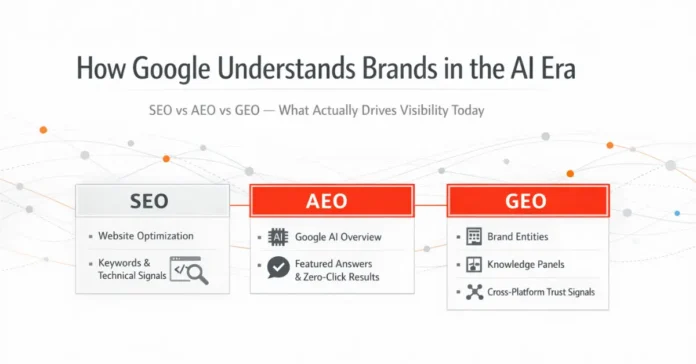
SEO vs AEO vs GEO (Simple Comparison)
SEO
- Focus: Ranking pages
- Output: Organic search listings
- Signals: Keywords, links, technical SEO
AEO
- Focus: Answer extraction
- Output: AI Overview, Featured Snippets
- Signals: Clear answers, schema, intent match
GEO
- Focus: Entity authority
- Output: Knowledge Panels, AI trust signals
- Signals: Brand consistency, citations, entity relationships
👉 Modern visibility happens when all three work together.
How Google Actually Understands Content Today
Google no longer “reads” pages like humans do.
It:
- Identifies entities
- Maps relationships
- Evaluates trust and authority
- Chooses answers, not just rankings
If your content:
- Answers questions clearly → AEO
- Establishes you as a trusted entity → GEO
- Is technically sound and relevant → SEO
You win.
How to Optimize for SEO, AEO, and GEO Together
1. Understand Search Intent Deeply
Don’t optimize for keywords — optimize for questions, problems, and decisions.
Ask:
- What is the user really trying to understand?
- What answer would satisfy them instantly?
2. Write Content That Teaches, Not Just Ranks
AI prefers content that:
- Explains concepts clearly
- Uses structured sections
- Avoids fluff and vague claims
Educational authority matters — especially if you’re a teacher or consultant.
3. Use Structured Data Properly
Schema helps Google understand:
- Who you are
- What your content represents
- How it should be categorized
Relevant schema types:
- Article
- FAQPage
- Organization
- Person
Reference standard implementation from:
👉 https://schema.org/docs/full.html
4. Build Entity Authority Beyond Your Website
GEO doesn’t live only on your site.
It grows through:
- Brand mentions
- Author bios
- Consistent naming
- Thought leadership content
Google trusts recognized entities, not isolated pages.
Why Most Marketers Get This Wrong
Most marketers:
- Chase rankings
- Ignore entity building
- Write for algorithms, not understanding
That’s why:
- Some sites rank but don’t get traffic
- Some brands appear everywhere without ranking #1
- AI answers bypass many “SEO-optimized” pages
Final Take: The Future of Search Belongs to Authorities
SEO brings visibility.
AEO brings answers.
GEO builds trust.
But authority brings longevity.
If you’re serious about growth in 2026 and beyond, stop optimizing only pages — and start optimizing knowledge, entities, and answers.
That’s how Google thinks now.
If you want your brand recognized, trusted, and presented by Google, it’s time to work with an SEO agency that understands SEO + AEO + GEO—not just keywords.
Frequently Asked Questions
What is AEO (Answer Engine Optimization)?
AEO (Answer Engine Optimization) is the process of optimizing content so search engines and AI systems can extract direct, clear answers to user questions.
It focuses on structured content, concise explanations, and intent-based responses rather than traditional rankings.
How is AEO different from SEO?
SEO focuses on ranking pages in search results, while AEO focuses on being selected as the answer itself in AI Overviews, featured snippets, and voice search.
SEO drives visibility; AEO drives instant answers.
What does GEO stand for in digital marketing?
GEO stands for Google Entity Optimization (also referred to as Generative Engine Optimization).
It focuses on helping Google understand and trust a brand, person, or business as a recognized entity, not just a website.
Why does Google show AI Overviews for some websites and not others?
Google selects content for AI Overviews based on:
- Clarity of answers
- Entity trust
- Structured formatting
- Authority signals
- Consistent data across the web
Websites that demonstrate expertise and credibility are more likely to appear.
Is SEO still relevant after Google AI Overviews?
Yes. SEO is still essential, but it is no longer sufficient on its own.
Modern visibility requires:
- SEO for crawlability and relevance
- AEO for answer selection
- GEO for brand authority
They now work together, not separately.
How can I optimize my content for Google AI Overviews?
To optimize for AI Overviews:
- Answer questions directly and early
- Use clear headings and subheadings
- Avoid fluff and generic content
- Add FAQ and Article schema
- Establish topical authority
Google prioritizes content that teaches clearly and accurately.
What type of content performs best for AEO?
Content that performs best for AEO includes:
- FAQs
- How-to guides
- Definitions and explanations
- Step-by-step breakdowns
- Educational content written by experts
The goal is clarity, not length.
What is an entity in Google Search?
An entity is anything Google can uniquely identify, such as:
- A brand
- A person
- A company
- A concept or topic
Google connects entities through data, mentions, and relationships to determine trust and authority.
How does Google build trust in a brand?
Google builds trust by analyzing:
- Consistent brand information
- Authoritative mentions
- Structured data
- Knowledge Graph connections
- Content depth and expertise
Trust is earned over time through credibility, not shortcuts.
Do I need schema markup for AEO?
Schema markup is not mandatory, but it significantly improves AEO performance.
It helps Google understand:
- Questions and answers
- Page intent
- Entity relationships
FAQ, Article, Organization, and Person schema are especially effective.
Can small businesses compete in AEO and GEO?
Yes. Small businesses can compete by:
- Focusing on niche expertise
- Answering specific questions better than large sites
- Optimizing for local and topical authority
- Maintaining consistent brand data
Authority beats size in modern search.
Does ranking #1 guarantee visibility anymore?
No. Ranking #1 does not guarantee visibility if:
- AI Overviews answer the query first
- Knowledge Panels appear
- Users get instant answers without clicking
Being understood and trusted matters more than ranking alone.
What is the biggest mistake marketers make with AI search?
The biggest mistake is optimizing for algorithms instead of understanding.
Google rewards content that:
- Educates
- Clarifies
- Demonstrates expertise
- Solves real problems
Not content that simply repeats keywords.
Is AEO the future of SEO?
AEO is not replacing SEO — it is evolving it.
The future belongs to marketers who optimize for:
- Search engines
- Answer engines
- Entity recognition
That’s how long-term visibility is built.